
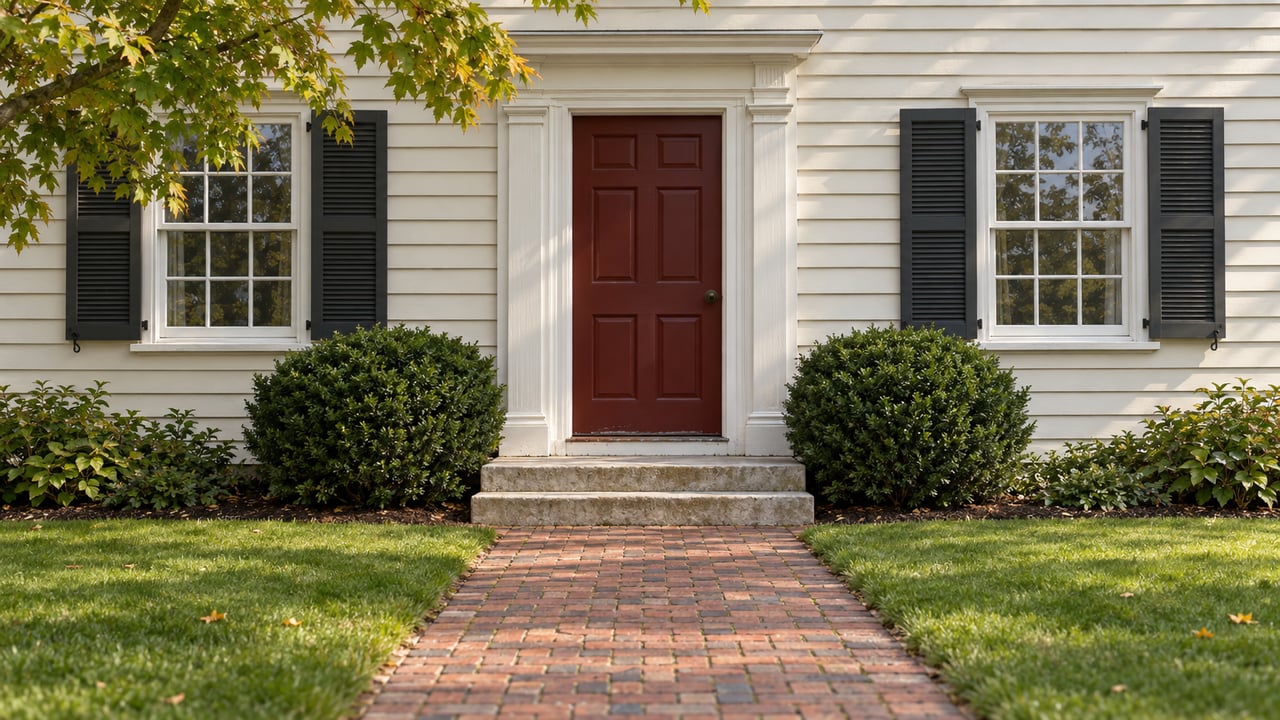
What happens if the person who has to sign off on your new siding hasn't met in six weeks?
That's not a hypothetical for anyone closing on a home near Long Grove's historic downtown this fall. The village's Architectural Commission, the body that reviews exterior changes and major remodeling within the B1 Historic Business Zoning District, meets once a month, skips January and February entirely, and currently lists two vacant seats on its roster. A buyer who assumes a village building permit is the only approval standing between them and a new roofline can lose a season waiting on a body that only convenes twelve times a year, and some years fewer.
Long Grove's own code of ordinances draws a hard line for anything inside the B1 district. The village board has determined that all construction and structures situated within the B1 zoning district must conform to the existing historical style and character of the historic business district, and it created the Architectural Commission specifically to enforce that standard. Under the village's code, the commission reviews all building permit applications for new construction and major remodeling within B1 and can withhold approval of any permit that doesn't match what the code calls the Long Grove style.
That means a standard village building permit and Architectural Commission approval are separate reviews, run by separate bodies, on separate timelines. A permit clerk can process paperwork on a normal municipal schedule. The commission can't move faster than its next scheduled meeting, no matter how complete the application is.
Not every project in Long Grove needs to clear this second gate, and not every property in the village sits under it. Interior work, kitchen remodels, bathroom updates, flooring, generally falls outside historic preservation review because the guidelines exist to protect the exterior character of the district, not what happens behind the walls. Exterior work is a different story.
| Project type | Typically reviewed | Typically not reviewed |
|---|---|---|
| Kitchen or bath remodel | Interior only | |
| New siding, windows, or roofing on a B1 property | Exterior change | |
| Repainting in a matching color | Routine maintenance | |
| Addition visible from the historic district | Design review | |
| New construction adjacent to a preserved building | Design review, even if the new structure isn't historic |
The village also draws a boundary around who this applies to. Properties within the designated historic downtown district face the most oversight, while many residential homes outside that immediate area are governed by standard village zoning instead. Confirming which category a specific parcel falls into, before writing an offer that assumes a fast renovation timeline, is worth a call to Village Hall rather than a guess based on how old the house looks.
The Architectural Commission meets on the third Monday of the month, except for January and February, with meetings starting at 7 p.m. at Long Grove Village Hall. That's ten regular meeting dates a year, not twelve. Miss the cutoff for a given month's agenda and the next chance is roughly four weeks out, longer if the meeting falls in the winter gap.
Layer on the current roster and the math gets tighter. The commission's own page currently lists two vacancies, which doesn't cancel meetings but does mean fewer people reviewing and discussing each application on any given Monday. A buyer closing in late October and hoping to start exterior work before winter is working against a body that next convenes October 19, then not again until November 16.
"...conform to the existing historical style and character of the historic business district."
That fragment of the village code is the reason the calendar matters as much as the contractor's schedule.
The Architectural Commission isn't necessarily the last word, either. Long Grove's planning and zoning staff note that most residential subdivisions in the village are Planned Unit Developments that overlap with homeowners associations, and those HOAs should be consulted early because their rules can independently limit what a homeowner is allowed to do, separate from whatever the village approves. A project that clears the village's historic review can still stall on an HOA architectural committee that has its own opinion about roofline changes or exterior color.
For a buyer evaluating a property under contract, that means two conversations before any renovation plan gets finalized: one with the village to confirm zoning and historic district status, and a second with the subdivision's HOA if the property sits inside one.
None of this is arbitrary. Long Grove's historic protections trace back to a 1960 village ordinance, which made it the first historic district created in Illinois. The cobblestone streets and restored storefronts that draw buyers to the village in the first place are the direct result of six decades of the same review process that now governs what a homeowner can do to a facade near downtown. The charm and the friction come from the same source.
The village also isn't standing still on the baseline rules underneath all of this. Effective June 1, 2026, Long Grove began requiring the 2021 editions of the International Residential Code and International Building Code, along with the 2023 National Electrical Code, for all new permit requests, an update mandated statewide under Illinois Public Act 103-0510. Anyone budgeting a renovation this year is working under a newer code baseline than someone who pulled a permit even twelve months ago, on top of whatever historic review applies.
For a buyer under contract on a property in or near the historic downtown, the practical sequence looks different than a typical suburban renovation. Confirm the parcel's zoning status before assuming historic review applies at all. If it does, separate the project into what's interior, which can usually start on a normal contractor schedule, and what's exterior, which needs to be mapped against the commission's actual meeting dates rather than an assumed permit timeline. Check whether the property sits inside a PUD with an HOA, and if so, start that conversation in parallel rather than after the village process is already underway.
None of this changes what makes Long Grove worth the wait. It does change when a new roof, new windows, or a visible addition actually gets built.
Does this apply to every home in Long Grove? No. The strictest oversight applies to properties within the designated B1 historic business district. Many residential homes outside that immediate area follow standard village zoning instead, though it's worth confirming a specific property's status directly with the village rather than assuming based on location.
If I only want to redo a kitchen, do I still need Architectural Commission approval? Generally no. Interior updates like kitchen and bathroom remodels typically fall outside historic preservation review, since the guidelines are aimed at exterior character and streetscape rather than interior living space.
Can HOA approval substitute for village review, or the reverse? No. They're separate processes. A project inside a PUD may need sign-off from both the homeowners association and, if applicable, the village's historic review, regardless of which one approves first.
Is there a way to speed up the Architectural Commission's timeline? Not by skipping a meeting date. The commission meets on a fixed monthly schedule except for January and February, so the practical lever is submitting a complete application well ahead of the desired meeting rather than trying to compress the review itself.
If you're evaluating a property in Long Grove's historic district and want a clear read on what a renovation timeline would actually look like before you write an offer, Valorie Schmidt can walk through the zoning status and next steps with you.

Whether you are just down the street or considering a move from another state, Valorie Schmidt is here to guide you through the exciting journey of real estate. Your dream home or a successful sale is just a conversation away.
OFFICE ADDRESS 508 S NORTHWEST HWY BARRINGTON IL 60010